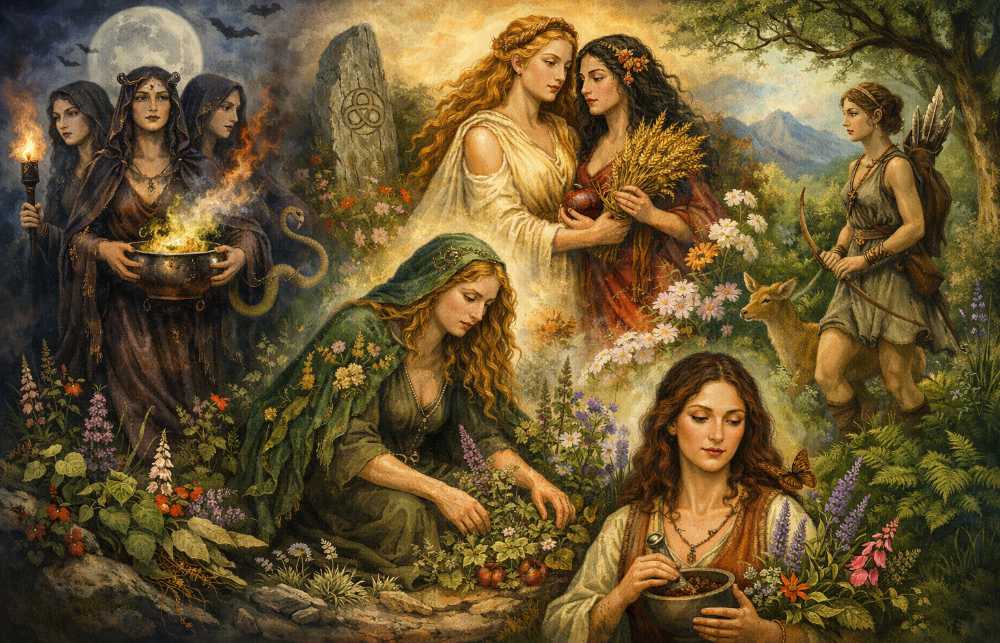
Green Goddesses in Literature and Art
Long after temple worship faded, the goddesses of herbs survived in a different sanctuary: the imagination of artists and writers. Their stories proved too rich to abandon. Across centuries, painters filled canvases with symbolic plants, poets wove botanical metaphors into verse, and novelists revived ancient figures as emblems of healing and wild knowledge.
What emerges from this creative afterlife is a recurring fascination with women who understand plants — not as decoration, but as power. These goddesses carry medicine, danger, fertility and memory in their hands. In art and literature, herbs become a language through which entire cultures wrestle with the meaning of nature.
Hecate and the Aesthetics of Darkness
Hecate’s artistic legacy is inseparable from mystery. In Shakespeare’s Macbeth, She appears as the hidden authority behind the witches, presiding over their herbal brew. The cauldron scene is thick with plant imagery: roots, seeds and toxic growths mingle into a potion that feels both medicinal and catastrophic. Shakespeare’s audience would have recognised the unsettling truth beneath the spectacle — that herbal knowledge could heal or destroy depending on the hand that wielded it.
Visual artists later embraced this ambiguity. William Blake’s haunting painting The Night of Enitharmon’s Joy (1795), often associated with Hecate-like symbolism, presents a triple-faced female figure surrounded by nocturnal forms. Though not labelled explicitly as Hecate, the imagery echoes her domain: shadow, crossroads and secret wisdom. Plants appear twisted and dreamlike, suggesting an herbal world beyond rational control.
In the 19th century, Symbolist painters frequently invoked her presence indirectly. The French artist Stéphane Mallarmé wrote poetry steeped in Hecatean atmosphere, where flowers and herbs feel charged with occult meaning. The goddess becomes less a character than a mood — a reminder that nature has a hidden vocabulary.
Airmed and the Art of Remembering
Airmed’s myth — herbs springing from grief — has quietly influenced Irish literary culture. During the Celtic Revival, writers such as W. B. Yeats explored the tension between lost knowledge and cultural survival. While Yeats rarely named Airmed directly, his poetry often returns to the idea of wisdom scattered and imperfectly reclaimed, a theme that resonates with her story.
Contemporary Irish artists have taken a more literal approach. The painter Jim Fitzpatrick, known for mythological and Celtic subjects, has produced works inspired by Tuatha Dé Danann figures, portraying them amidst intricate botanical detail. In these visual interpretations, plants are not background scenery; they are luminous carriers of memory.
Airmed’s presence in modern eco-literature is particularly striking. She has become a symbol for environmental fragility — a figure who embodies knowledge humanity cannot afford to lose. Poets invoke her when writing about disappearing species, turning her cloak of herbs into a metaphor for biodiversity itself.
Demeter and Persephone: The Botanical Cycle on Canvas
Few myths have generated as much plant-rich imagery as the story of Demeter and Persephone. Their narrative — descent, return and seasonal rebirth — offers artists a ready-made structure for exploring nature’s rhythms.
Dante Gabriel Rossetti’s Proserpine (1874) is one of the most famous interpretations. Persephone stands in shadow holding a pomegranate, surrounded by ivy. The plant is not incidental. Ivy symbolises persistence and entanglement, mirroring her captivity. Victorian audiences, fluent in floral symbolism, would have read the painting as a meditation on growth constrained but never extinguished.
Frederic Leighton’s The Return of Persephone (1891) shifts the mood toward release. Flowers spill across the composition as she rises, suggesting that plant life itself celebrates her return. Here the goddess becomes indistinguishable from the landscape; she is the season incarnate.
Demeter, often painted with wheat and medicinal herbs, appears as civilisation’s green architect. In many neoclassical works, artists place cultivated plants alongside wild growth, quietly acknowledging that agriculture and healing once shared the same botanical roots.
Artemis and the Feminine Wilderness
Artemis represents another artistic current: the woman aligned with untamed landscapes. Classical sculptures show her striding forward, animals and forest plants carved at her side. These vegetal details signal that she belongs to ecosystems beyond human control.
Romantic painters expanded this theme dramatically. Théodore Chassériau’s Diana Surprised (1840) situates Artemis within dense foliage that feels alive with motion. The surrounding herbs and trees are not passive scenery; they seem to protect her, reinforcing her identity as guardian of wild spaces.
In modern literature, Artemis frequently appears in feminist reinterpretations. Novelists recast her as an emblem of bodily autonomy and ancestral knowledge, linking her to midwives and herbal healers pushed to society’s margins. The forest becomes a site of alternative authority — a place where plant wisdom survives outside institutional power.
The Persistent Image of the Herbal Woman
Across centuries of art and literature, these goddesses converge into a single enduring figure: the herbal woman. She stands at the threshold between culture and wilderness, holding knowledge both intimate and unsettling. Painters render her surrounded by symbolic plants; writers give her a voice that speaks in roots and leaves.
What keeps this archetype alive is its adaptability. In Gothic tales, she becomes the witch. In pastoral poetry, the healer. In environmental art, the guardian of fragile ecosystems. Each era reshapes her to reflect contemporary anxieties about nature, medicine and control.
Yet the core image remains constant. She is the reminder that human life has always depended on careful attention to plants — their cycles, their dangers, their gifts. By returning again and again to herbal goddesses, artists and writers acknowledge a truth older than myth: the green world is not a backdrop to history, but one of its central characters.
And in galleries and libraries, the goddesses continue their quiet work, keeping botanical memory alive in pigment and prose.

Spices have always had a way of stirring things up—sometimes literally, sometimes politically. They’ve flavoured soups, sparked wars, inspired travel, and even ruined royal stomachs. From kings with extravagant tastes to entertainers who couldn’t resist a bit of chilli heat, spice lovers have popped up in every corner of history. Let’s take a wander through their peppery passions.
Monarchs Who Wouldn’t Settle for Bland
Medieval rulers adored spices. They weren’t just a seasoning; they were a status symbol. If you were rich, you didn’t just sprinkle cinnamon—you poured it on like confetti at a parade.
Take King Richard II of England. His kitchen records show he went through saffron like it was table salt. Saffron remains the most expensive spice in the world today. Imagine his cooks: “Your Majesty, we’ve used today’s entire supply in one pie. Should I order another cartload?”
Over in France, Louis XIV had an entire court culture that revolved around showy food, with nutmeg, cloves, and cinnamon making their way into every dish. Spices were as much about power as taste—if you could afford them, you could show off.
And let’s not forget Queen Elizabeth I. She had such a fondness for gingerbread that she even had biscuits shaped like her own face. If that’s not the ultimate ego snack, what is?
Explorers with Pepper Fever
Spices didn’t just stay in kitchens. They launched ships. Christopher Columbus went west looking for pepper and cinnamon. He didn’t find them, but he did stumble across chilli peppers in the Americas, which Europeans quickly adopted. They liked the heat but were a bit puzzled—where were the “real” spices?
Vasco da Gama actually did manage to find India by sea, opening the floodgates for the Portuguese spice trade. He brought back black pepper, cinnamon, and other wonders that suddenly made European dishes taste less like boiled cabbage and more like something you’d actually want to eat.
Even Magellan’s crew, though most of them didn’t survive the voyage, managed to return with a shipload of cloves. That single haul of spice was worth more than the expedition itself. Imagine being one of the few sailors who lived: “I’ve lost all my friends, but at least I’m sitting on a fortune in cloves.”
Chefs Who Went Heavy-Handed
Of course, without cooks, all that pepper and cinnamon would just gather dust in jars. Some chefs throughout history have been true spice fanatics.
Take Apicius, the Roman food writer. His cookbook, De Re Coquinaria, is filled with spice-heavy recipes—pepper was everywhere, often drowning out the other flavours. Roman diners apparently enjoyed food that scorched their tongues and wallets in equal measure.
Fast-forward to the 20th century and you get Julia Child, who introduced French cooking to North America with lashings of herbs and spices. She wasn’t shy about garlic either, declaring that no proper cook should be afraid of it. The woman was practically a garlic activist.
And then there’s Madhur Jaffrey, who revolutionised how Western audiences thought about Indian spices. Her recipes showed that cumin, coriander, turmeric, and cardamom could transform the dullest stew into something extraordinary.
Entertainers Who Craved Heat
It’s not just monarchs and explorers—performers have also been spice enthusiasts.
Elvis Presley famously adored fried peanut butter and banana sandwiches, but he was also partial to spicy southern dishes loaded with cayenne and paprika. Maybe that hip-shaking wasn’t just rhythm—it could’ve been indigestion.
In more recent years, Chrissy Teigen has built an empire partly on her love of hot, spicy food. Her cookbooks celebrate chillies and bold flavours, proving that spice is as Instagrammable as it is tasty.
Even George Clooney has dipped into the spice game, though via tequila. Agave isn’t exactly a spice, but tequila cocktails often involve chilli salt rims and spicy syrups. If Clooney is serving them, they count.
Spice: The Great Connector
What’s striking is how universal spice love has been. Monarchs hoarded it, explorers chased it, chefs worshipped it, and entertainers flaunted it. Spices were currency, medicine, and magic dust all rolled into one.
They’ve also been troublemakers. Empires were built and torn apart over nutmeg. Cooks were fired (or worse) for skimping on saffron. And even today, friendships can be tested over who can handle the hottest curry.
So, whether you’re tossing cinnamon into porridge, splashing chilli oil on dumplings, or sipping a spiced cocktail, you’re part of a long, quirky tradition. History isn’t just written in battles and treaties—it’s written in peppercorns and gingerbread biscuits too.

The gentle waft of spices from a simmering pot does more than just tickle your nose; for eons, these aromatic powerhouses have been deeply entwined with a rich tapestry of myths, folklore, and deeply held superstitions. From warding off malevolent spirits to practically coaxing prosperity from thin air, the humble herb and the exotic spice have transcended their role as mere ingredients. They’ve become fascinating vessels of belief, reflecting humanity’s enduring quest for comfort, control, and, let’s be honest, a little bit of good fortune.
Garlic: The Pungent Protector
Think of garlic, and your mind might jump straight to warding off vampires. And you wouldn’t be wrong! This pungent powerhouse is arguably one of the most universally recognized protective spices. Its unmistakable aroma and potent flavor have long been associated with repelling evil. In much of Europe, particularly in Balkan and Slavic cultures, garlic cloves strategically hung in windows or even worn around the neck were believed to deter everything from vampires to witches and other shadowy, nocturnal entities. This isn’t just movie magic, either; the superstition seeped right into the kitchen. People would use garlic liberally in their dishes, especially during vulnerable times like New Year’s Eve, to purify the food and, by extension, protect those who ate it. Even today, the symbolic might of garlic as a safeguard against unseen forces hangs around in many communities, sometimes just as a playful nod to ancient wisdom.
Salt: More Than Just a Seasoning
And then there’s salt. Ah, salt! It’s so much more than just a seasoning, isn’t it? Since antiquity, this humble crystal has been revered for its purifying and preserving magic. That age-old ritual of flinging a pinch of spilled salt over your left shoulder? It’s not just an old wives’ tale; many genuinely believe it blinds the devil or sends bad luck packing. This tradition likely sprang from ancient beliefs that the devil or evil spirits hung out over your left shoulder, just waiting for an opportunity. In countless cultures, salt gets sprinkled around homes to create invisible barriers against wicked spirits or is lovingly used in blessings for new homes and even new babies. Its use in the kitchen often carries an unspoken reverence for its protective powers, making sure the food stays pure and safe from any unsavory influences.
Cinnamon & Cloves: Sweetness and Fortune
Beyond simply protecting us, some spices are believed to draw in good fortune. Take cinnamon, for instance. With its warm, sweet aroma, it’s often linked directly to prosperity, love, and cold, hard cash. In various traditions, including Hoodoo and certain Asian folk practices, a simple act like sprinkling cinnamon powder on your doorstep or tucking a stick into your wallet is thought to magically attract wealth. So, if you’ve ever wondered why grandma insists on extra cinnamon in her holiday treats, it’s not just for flavor; there’s often an underlying hope for abundance and sweetness baked right in. Similarly, cloves are incredibly versatile in folklore, used for protection, love, and money-drawing. Burning cloves or keeping them in small sachets is a practice rooted in their perceived ability to dispel negative vibes and usher in positive outcomes, extending their role far beyond just flavoring a holiday ham.
Chili Peppers & Bay Leaves: Fire, Fortune, and Future
And let’s not forget the fiery myths of chili peppers. While their heat is undeniably a culinary force, many cultures credit them with protective qualities, especially against the dreaded “evil eye.” In places like Turkey and Greece, you’ll still see strings of dried red peppers proudly hung outside homes or businesses, a vibrant visual shield meant to deflect jealousy and ill will. Their bright color and potent kick are believed to symbolize a forceful rejection of negative energies. In parts of Latin America and Asia, adding chili to dishes isn’t merely about turning up the heat; it’s also about symbolically invigorating the spirit and burning away bad luck.
Less talked about, but equally fascinating, are the beliefs wrapped around bay leaves. The ancient Greeks and Romans held these leaves in high esteem, linking them to Apollo and prophecy. Priestesses would even chew them to induce visions, and it was widely believed they could grant wishes. Today, some folk traditions suggest writing a wish on a bay leaf and either burning it or tucking it under your pillow, hoping to make dreams a reality. So, when a bay leaf finds its way into your stew, it might subtly carry a hidden hope for clarity, success, or just a little spark of inspiration.
These culinary superstitions, carefully passed down through generations, beautifully highlight our innate desire to infuse everyday life with a bit of magic and meaning. Whether they sprang from ancient religious rites, clever observations of natural properties, or simply the comforting embrace of tradition, these beliefs remind us that food is never just about sustenance. It’s a powerful conduit for culture, a shield against the unknown, and often, a whispered prayer for a better tomorrow, seasoned generously with the invisible power of myth and memory.

