
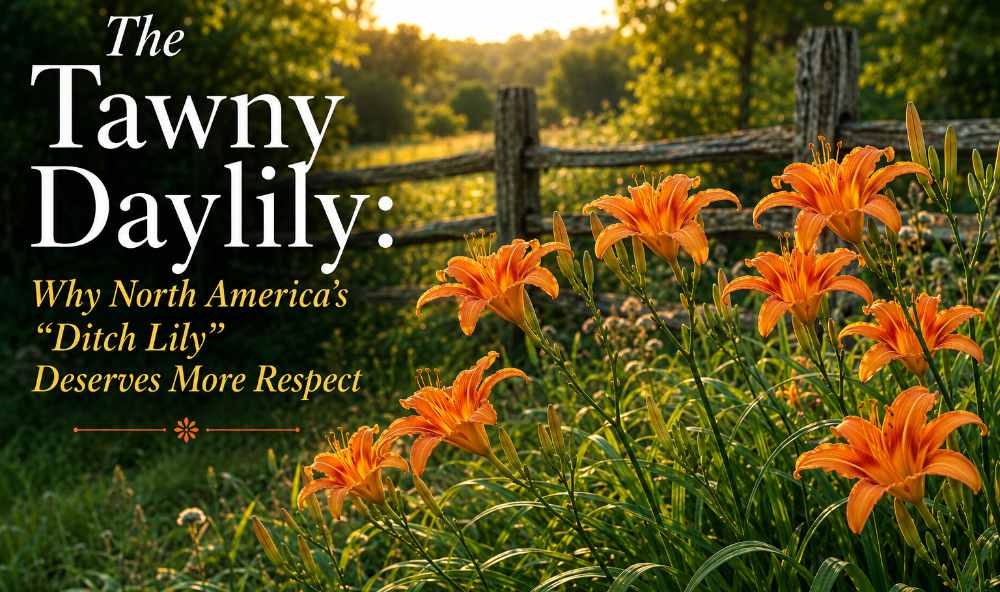
Often dismissed as the “ditch lily,” the tawny daylily has a remarkable history that stretches from ancient China to the roadsides of North America.Any flower that’s brightened gardens, fed families, and survived for centuries deserves a better nickname than “ditch lily.”
Every July, roadsides across much of Canada and the northern United States erupt into brilliant ribbons of orange. These cheerful flowers have become such a fixture of the summer landscape that most of us drive right past without a second glance. When we do notice them, they usually get lumped in with the “ditch lily” crowd — a name that makes them sound like a weed that showed up uninvited and refused to leave.
Turns out, that reputation is more than a little unfair.
The tawny daylily (Hemerocallis fulva) has travelled halfway around the world, fed generations of people, outlasted entire homesteads, and still shows up every summer looking effortlessly good — no fertilizer, no fussing, no watering schedule. Behind that humble roadside presence is a genuinely interesting story.
From Imperial Gardens to Country Roads!
The tawny daylily got its start in China, where people have been growing it for more than two thousand years — treasured both as a garden flower and as a food crop long before anyone in North America had heard of it. From there it spread through Korea and Japan and eventually made its way west along old trade routes into Europe.
European settlers brought it across the Atlantic in the 1600s and 1700s and planted it around homes, churches, cemeteries, and farmyards for one simple reason: it was next to impossible to kill.
Many of the sprawling roadside patches we see today started out as those original garden plantings. The farmhouses are long gone, the families who planted them are long gone, but the daylilies just kept going, quietly spreading a little further every year. In a lot of places, they’re essentially the last visible sign that someone used to live there.
Not Actually a Lily
Here’s a fun bit of trivia: the daylily isn’t a true lily at all.
Real lilies belong to the genus Lilium. Daylilies are Hemerocallis, from the Greek for “beauty for a day” — which is a pretty on-the-nose name once you know how the flower works. Each bloom opens in the morning, looks fantastic for about twelve hours, and folds up for good by evening. Sounds like a rough deal for the flower, but each stalk carries a whole string of buds that open one after another, so a healthy clump can keep blooming for weeks. One well-established patch can pump out hundreds of flowers over a summer — it’s basically running a relay race with itself.
Built Like a Tank
If there were an award for sheer stubbornness in the plant world, the tawny daylily would be bringing home the trophy every year.
It shrugs off drought, clay soil, road salt, blazing heat, and Canadian winters that would send most garden plants packing. Its underground rhizomes let it spread steadily into dense colonies that can carry on for decades with zero attention from anyone.
That’s exactly why it ended up associated with ditches and roadsides in the first place — those are simply the spots where nothing fussier could survive. Which means the very toughness that earned it a slightly insulting nickname is actually its best feature. A bit of an image problem, really.
Yes, You Can Eat It
Here’s the part that surprises most gardeners: throughout Asia, the daylily has long done double duty as a vegetable.
The unopened flower buds are dried and sold as “golden needles,” a common ingredient in dishes like hot-and-sour soup and Buddha’s Delight. Young spring shoots are edible too, and fresh blooms can be stuffed, battered, or tossed into a salad. The flavour is mild and a little sweet, often compared to green beans or asparagus.
As with any wild edible, correct identification matters — and while most people handle daylilies just fine, a few can get an upset stomach. One important note: true lilies are not edible, and they’re highly toxic to cats. So if you’ve got a curious cat and a garden full of actual lilies, that’s worth knowing regardless of what you do with your daylilies.
A Pit Stop for Pollinators
Even though each bloom only lasts a day, it’s generous while it’s open — plenty of nectar and pollen on offer. Honeybees, native bees, butterflies, and hummingbirds all make a point of visiting. The tawny daylily isn’t native to North America, but it still pulls its weight for the local pollinator crowd during the height of summer.
It’s an easy plant to overlook if you’re building a garden with wildlife in mind, but it’s quietly doing its part year after year without being asked.
Weed or Wildflower?
Not everybody’s a fan, and that’s fair.
Because it spreads so readily through its rhizomes, some conservation groups consider it invasive in certain areas — particularly where it escapes cultivated spaces and starts crowding out native plants.
Gardeners, on the other hand, tend to see it differently. Many treat it as a kind of living heirloom, a link back to the pioneer families who planted it generations ago. Others just appreciate that it delivers weeks of colour without asking for anything in return.
Both views probably have a point. Like a lot of introduced plants, the tawny daylily is at its best where it was put on purpose — gardens, country roadsides, old homestead sites — rather than muscling into sensitive natural areas where it wasn’t invited.
A Flower Full of Surprises
The more you dig into the tawny daylily’s story, the better it gets:
- Each bloom lasts a single day, yet one mature plant can produce hundreds of flowers in a season.
- Plenty of roadside patches are likely over a century old.
- It’s fed people for thousands of years.
- It survives conditions that would finish off far more pampered garden plants.
- Every summer, it turns ordinary country roads into rivers of orange.
Not bad at all for something most people write off as a weed.
Maybe It’s Time for a Better Name
Words matter. Calling this plant a “ditch lily” is a bit like calling a heritage stone cottage a shack — the nickname is all about where it’s found, not what it actually is.
“Tawny daylily” is a far better fit for a plant with this much history, this much resilience, and this much genuine beauty.
So next time you drive past a blaze of orange along a country lane, take a second look. You’re not looking at a weed. You’re looking at one of North America’s oldest surviving garden plants — a traveller that made its way here from ancient China and quietly became part of our summer scenery.
Sometimes the flowers we know best turn out to have the most surprising stories.
