
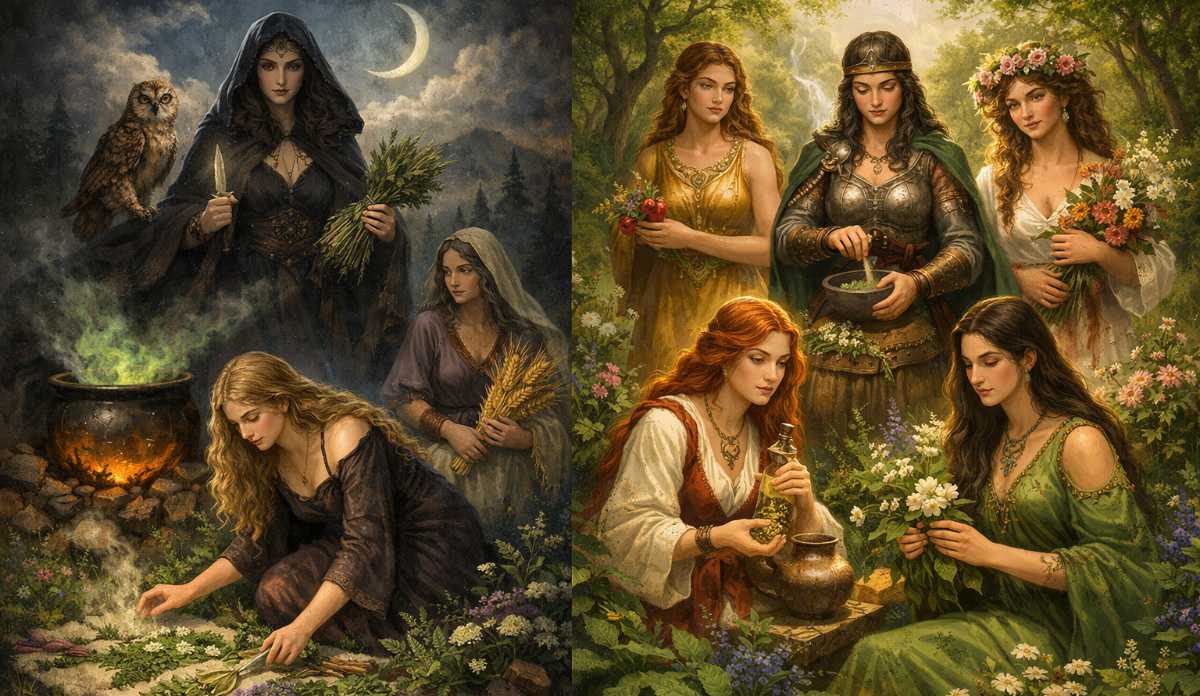
From the mist-shrouded hills of Ireland to the olive groves of ancient Greece, the myths of many cultures celebrate goddesses who embody the spirit of plants, especially herbs. These deities were more than just mythical figures — they stood at the intersection of nature, medicine and magic, representing the powerful, often mysterious relationship between humans and the plant world.
But what exactly makes a goddess of herbs? It isn’t simply a matter of gardening prowess. These divine figures symbolise an ancient understanding of herbal wisdom — knowledge of how plants can heal, harm, or transform the human body and spirit. In a world before modern pharmacology, herbs were medicine, food, perfume and magic. And tucked into the stories of old are countless goddesses whose realms included these living medicines.
Hecate: Sovereign of Plant Lore and Mysteries
Perhaps one of the most evocative figures associated with herbs is Hecate, the Greek goddess of magic, crossroads and the night. Far from being a benign garden spirit, she embodies the wild, liminal edges of nature — the places where medicinal and poisonous plants can grow side by side. Ancient lore credits her with teaching the arts of concocting potions, medicines and poisons, instructing practitioners in the power of herbs like mandrake, belladonna and aconite.
Her connection to garlic — used in antiquity both for protection and healing — and other plants reflects her dual nature as a deity of both healing and danger. Hecate’s gardens are not neatly ordered like kitchen herb beds, but wild and unpredictable, filled with potent plant power for those bold enough to seek it.
Such stories remind us that in many ancient worldviews, healing and harm existed on a spectrum. The same herb might cure a fever at one dose and bring death at another. A goddess like Hecate was revered precisely because she understood this delicate balance.
For more on Hecate’s plant associations, see this detailed source on her links to herbal knowledge.
Airmed: Ireland’s Mistress of Medicinal Plants
In the lush landscapes of Ireland, Airmed occupies a unique and poignant role in myth. As one of the Tuatha Dé Danann, the supernatural ancestors of the Irish, she was deeply connected to healing and the knowledge of herbs. According to legend, after her brother Miach was slain, Airmed wept over his body. From her tears sprang every healing herb in existence — 365 in all, representing every part of the human body and every possible cure.
With loving care, she laid these herbs out on her cloak and catalogued their properties. But her father, jealous and fearful of such wisdom, scattered them across the earth. This myth explains why humans can never fully master the secrets of herbalism — only Airmed holds the complete knowledge.
That story captures something timeless: the sense that the essence of true healing is mysterious and perhaps only partially accessible to mortals. In folklore, Airmed has come to symbolise the soul of herbal healing, a guardian of plant lore whose knowledge cannot be lost.
For more on Airmed’s story
The Greek Daughters of Healing: Panacea and Her Sisters
Not all plant-linked goddesses were solitary figures perched on distant hills. In Greek myth, the daughters of Asclepius — the great god of medicine — collectively represent aspects of healing itself, with strong ties to plant medicine. Among them is Panacea, whose very name endures in the modern word for a universal cure. She was thought to possess an herb capable of healing any ailment, an idea that speaks to humanity’s deep longing for comprehensive, natural remedies.
Her sisters, such as Hygieia (health and cleanliness) and Iaso (healing), flesh out a broader picture of Greek attitudes toward wellness, where herbs and plant-based remedies were central to the art of healing. This interweaving of divine metaphor and medical practice shows how deeply herb lore was embedded in ancient culture.
Other Goddesses in the Garden
Across cultures, the idea of plant-linked deities appears again and again:
• Artemis, the Greek huntress, was associated with wild herbs of the forest, including dittany — a plant believed to draw arrows from wounds.
• Demeter, goddess of agriculture, oversaw the growth of grain and other cultivated plants, some of which had medicinal uses in folk remedies.
• In Roman myth, Flora, goddess of flowers and spring, presided over the bloom of herbs and plants that sustained life and health.
• Norse mythology’s Eir embodies healing and is often portrayed as a benevolent figure tied to restorative practices.
• Many other cultures — from Yoruba traditions to Baltic folklore — ascribe plant-linked powers to female spirits and goddesses, emphasising the universal resonance of women and nature in myth.
While not all these figures are strictly “herb goddesses” in the narrowest sense, they reflect a widespread mythological theme: the belief that the earth’s healing powers are guided by divine feminine forces.
Why These Myths Still Matter
In an age of scientific medicine, the idea of a goddess of herbs can seem quaint or symbolic. Yet these ancient stories capture something essential about the human relationship with nature: respect, curiosity and sometimes awe before the hidden forces of plant life. Herbs aren’t just chemical compounds; in many cultures they were — and are — seen as living allies, with spirits or deities guarding their secrets.
Whether you’re a gardener, herbalist, historian or simply a lover of myth, these stories invite us to consider the deep roots of plant wisdom and the ways in which we continue to seek healing from nature. In the old tales, goddesses aren’t just mythical figures — they are reminders that the world of plants is mysterious, potent and fundamentally intertwined with human life.
🌿 Greek tradition
Hecate — Goddess of witchcraft, crossroads, and herbal magic
Associated with poisonous and medicinal plants. Ancient herbalists invoked her in spellwork and pharmakeia (plant medicine + magic).
Demeter — Agriculture and cultivated plants
Not specifically herbs, but guardian of plant cycles, fertility, and grain — she represents the domestication of useful plants.
Artemis — Wilderness and women’s healing
Linked to midwifery and protective herbs used in childbirth.
Persephone — Spring growth and plant rebirth
Symbolizes seasonal regeneration — the hidden life of roots and bulbs.
🌱 Roman tradition
Flora — Flowers and blossoming plants
Patron of spring blooms, perfumes, and flowering herbs.
🍃 Celtic traditions
Brigid (Brighid) — Healing, poetry, and sacred wells
Strongly tied to herbal healing and folk medicine. Many Irish herbal charms invoke her.
Airmed — Celtic goddess of herbal knowledge
According to myth, all healing herbs sprang from her tears. She catalogued every plant’s medicinal use.
🌺 Norse tradition
Eir — Goddess of healing
Sometimes described as the greatest physician among the gods. Associated with medicinal knowledge, likely including herbs.
🌼 Egyptian tradition
Isis — Magic and healing
Used divine herbal knowledge to resurrect Osiris and cure poison. Egyptian medicine blended plants and ritual.
🌾 Slavic tradition
Živa / Siva — Life and vegetation goddess
Linked to growth, greenery, and life force
