
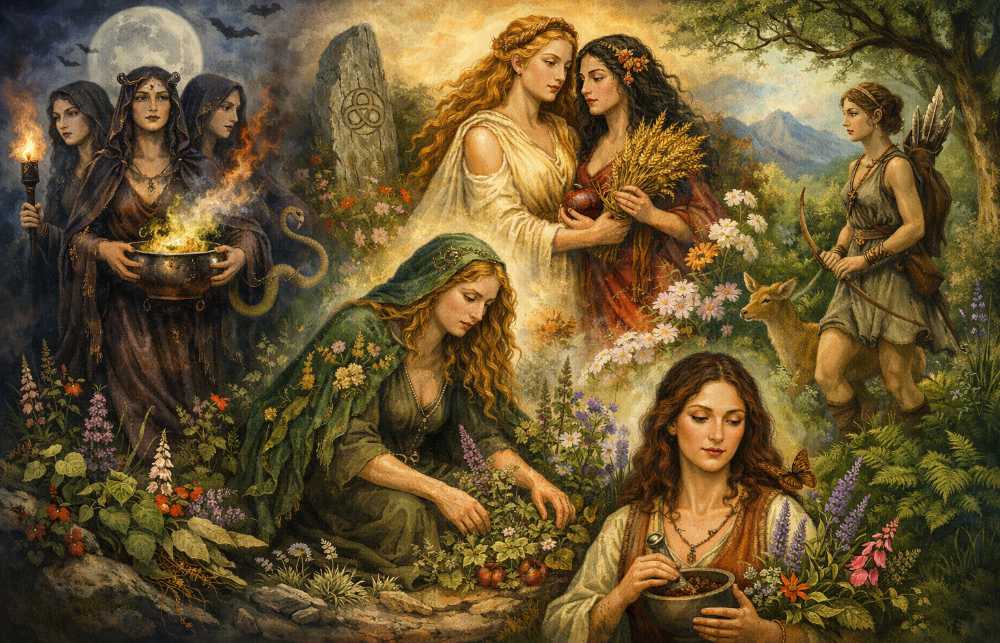
Green Goddesses in Literature and Art
Long after temple worship faded, the goddesses of herbs survived in a different sanctuary: the imagination of artists and writers. Their stories proved too rich to abandon. Across centuries, painters filled canvases with symbolic plants, poets wove botanical metaphors into verse, and novelists revived ancient figures as emblems of healing and wild knowledge.
What emerges from this creative afterlife is a recurring fascination with women who understand plants — not as decoration, but as power. These goddesses carry medicine, danger, fertility and memory in their hands. In art and literature, herbs become a language through which entire cultures wrestle with the meaning of nature.
Hecate and the Aesthetics of Darkness
Hecate’s artistic legacy is inseparable from mystery. In Shakespeare’s Macbeth, She appears as the hidden authority behind the witches, presiding over their herbal brew. The cauldron scene is thick with plant imagery: roots, seeds and toxic growths mingle into a potion that feels both medicinal and catastrophic. Shakespeare’s audience would have recognised the unsettling truth beneath the spectacle — that herbal knowledge could heal or destroy depending on the hand that wielded it.
Visual artists later embraced this ambiguity. William Blake’s haunting painting The Night of Enitharmon’s Joy (1795), often associated with Hecate-like symbolism, presents a triple-faced female figure surrounded by nocturnal forms. Though not labelled explicitly as Hecate, the imagery echoes her domain: shadow, crossroads and secret wisdom. Plants appear twisted and dreamlike, suggesting an herbal world beyond rational control.
In the 19th century, Symbolist painters frequently invoked her presence indirectly. The French artist Stéphane Mallarmé wrote poetry steeped in Hecatean atmosphere, where flowers and herbs feel charged with occult meaning. The goddess becomes less a character than a mood — a reminder that nature has a hidden vocabulary.
Airmed and the Art of Remembering
Airmed’s myth — herbs springing from grief — has quietly influenced Irish literary culture. During the Celtic Revival, writers such as W. B. Yeats explored the tension between lost knowledge and cultural survival. While Yeats rarely named Airmed directly, his poetry often returns to the idea of wisdom scattered and imperfectly reclaimed, a theme that resonates with her story.
Contemporary Irish artists have taken a more literal approach. The painter Jim Fitzpatrick, known for mythological and Celtic subjects, has produced works inspired by Tuatha Dé Danann figures, portraying them amidst intricate botanical detail. In these visual interpretations, plants are not background scenery; they are luminous carriers of memory.
Airmed’s presence in modern eco-literature is particularly striking. She has become a symbol for environmental fragility — a figure who embodies knowledge humanity cannot afford to lose. Poets invoke her when writing about disappearing species, turning her cloak of herbs into a metaphor for biodiversity itself.
Demeter and Persephone: The Botanical Cycle on Canvas
Few myths have generated as much plant-rich imagery as the story of Demeter and Persephone. Their narrative — descent, return and seasonal rebirth — offers artists a ready-made structure for exploring nature’s rhythms.
Dante Gabriel Rossetti’s Proserpine (1874) is one of the most famous interpretations. Persephone stands in shadow holding a pomegranate, surrounded by ivy. The plant is not incidental. Ivy symbolises persistence and entanglement, mirroring her captivity. Victorian audiences, fluent in floral symbolism, would have read the painting as a meditation on growth constrained but never extinguished.
Frederic Leighton’s The Return of Persephone (1891) shifts the mood toward release. Flowers spill across the composition as she rises, suggesting that plant life itself celebrates her return. Here the goddess becomes indistinguishable from the landscape; she is the season incarnate.
Demeter, often painted with wheat and medicinal herbs, appears as civilisation’s green architect. In many neoclassical works, artists place cultivated plants alongside wild growth, quietly acknowledging that agriculture and healing once shared the same botanical roots.
Artemis and the Feminine Wilderness
Artemis represents another artistic current: the woman aligned with untamed landscapes. Classical sculptures show her striding forward, animals and forest plants carved at her side. These vegetal details signal that she belongs to ecosystems beyond human control.
Romantic painters expanded this theme dramatically. Théodore Chassériau’s Diana Surprised (1840) situates Artemis within dense foliage that feels alive with motion. The surrounding herbs and trees are not passive scenery; they seem to protect her, reinforcing her identity as guardian of wild spaces.
In modern literature, Artemis frequently appears in feminist reinterpretations. Novelists recast her as an emblem of bodily autonomy and ancestral knowledge, linking her to midwives and herbal healers pushed to society’s margins. The forest becomes a site of alternative authority — a place where plant wisdom survives outside institutional power.
The Persistent Image of the Herbal Woman
Across centuries of art and literature, these goddesses converge into a single enduring figure: the herbal woman. She stands at the threshold between culture and wilderness, holding knowledge both intimate and unsettling. Painters render her surrounded by symbolic plants; writers give her a voice that speaks in roots and leaves.
What keeps this archetype alive is its adaptability. In Gothic tales, she becomes the witch. In pastoral poetry, the healer. In environmental art, the guardian of fragile ecosystems. Each era reshapes her to reflect contemporary anxieties about nature, medicine and control.
Yet the core image remains constant. She is the reminder that human life has always depended on careful attention to plants — their cycles, their dangers, their gifts. By returning again and again to herbal goddesses, artists and writers acknowledge a truth older than myth: the green world is not a backdrop to history, but one of its central characters.
And in galleries and libraries, the goddesses continue their quiet work, keeping botanical memory alive in pigment and prose.
